Hey, I'm Anand Bodh, founder and CEO of DoctorGPT. This isn't your typical "why I built my startup" story. This is about a fundamental problem in healthcare that's been bugging me for years: and why I believe we're finally in a position to fix it.
The Problem Nobody's Talking About
Here's something most people don't realize: Healthcare runs on one-time snapshots. A patient walks into your OPD with a fever, cough, maybe some body aches. You take their vitals, ask questions, examine them, and prescribe treatment. They walk out. And then... crickets.
Did the antibiotics work? Did the fever break on Day 3 or Day 5? Did they develop any complications? Did they recover fully, or are they still dealing with lingering symptoms?
Most doctors have no idea.
And it's not their fault. The system isn't designed to capture this information. We've built healthcare around episodic visits, not continuous learning. Each consultation exists in isolation, like a photograph instead of a video.
Why This Matters More Than You Think
When I started working in healthtech, I was stunned by how little feedback doctors actually get about their treatment outcomes. Think about it, in almost every other field, practitioners get rapid feedback:
Software developers see if their code works immediately. Teachers get test scores and student progress reports. Even restaurants know if their food is good based on reviews.
But doctors? They prescribe medication and rarely hear back unless something goes terribly wrong.
This broken feedback loop has massive consequences: For doctors: You can't improve what you can't measure. Without patient outcome tracking, every diagnosis is based on training, experience, and intuition: but not data from your own practice.
For patients: Especially in chronic patient, the lack of follow-up means symptoms can worsen, complications can develop, and diseases can progress unchecked.
For healthcare systems: We're stuck in a reactive model. We only see patients when they're sick enough to come back, not when early intervention could prevent bigger problems.
The "Aha" Moment
The idea for DoctorGPT clicked for me during a conversation with Dr. Mehta, a general physician running a busy clinic in Delhi. He sees 50-60 patients a day. His waiting room is packed. He's exhausted. I asked him, "How do you know if your treatments are working?" He laughed. "I don't, unless they come back. And they usually only come back if something went wrong." That's when it hit me: We need to turn healthcare from a series of snapshots into a continuous learning system.
Enter DoctorGPT: A Clinical AI Assisant That Actually Learns
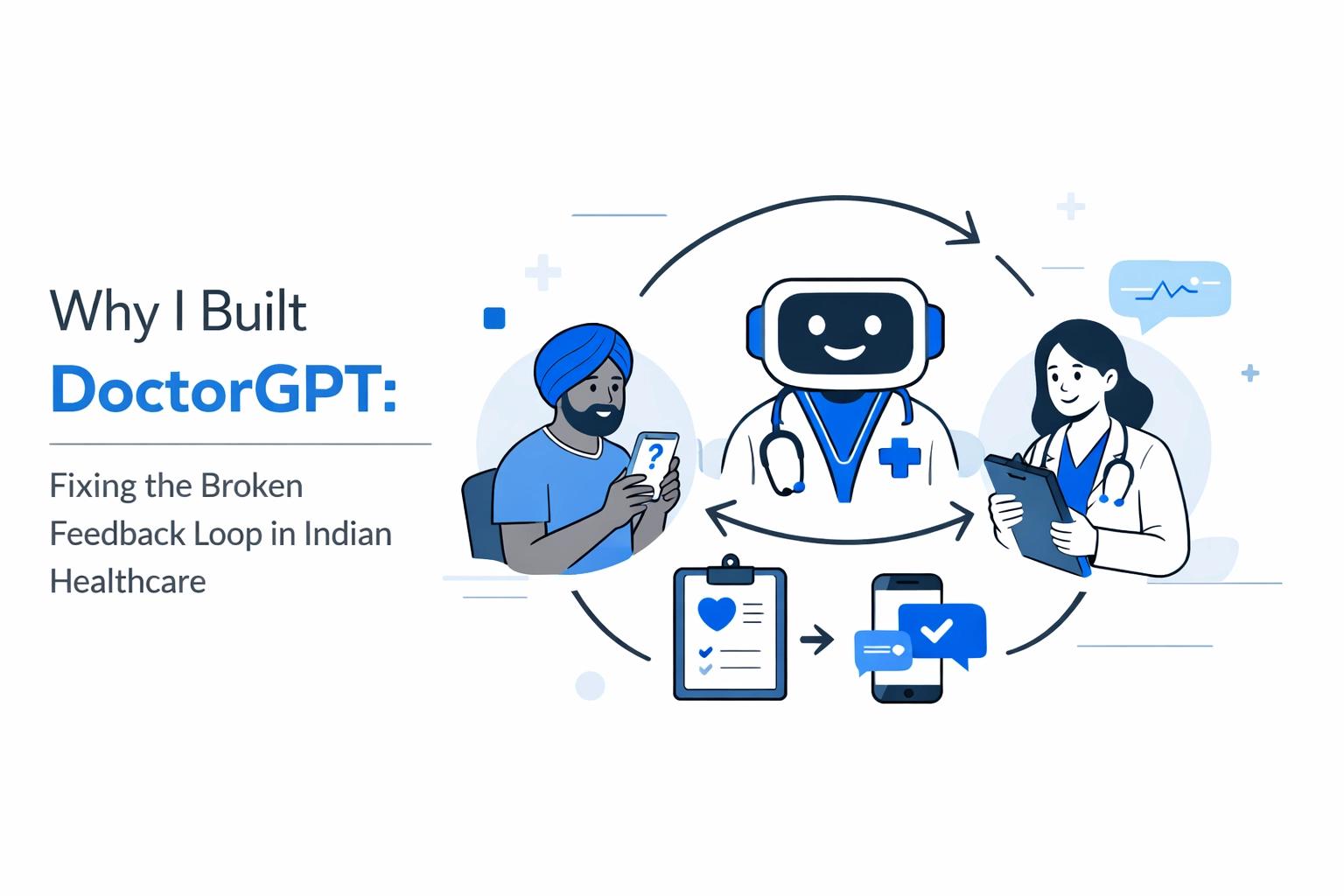
DoctorGPT isn't just another AI medical assistant. It's not trying to be a replacement for doctors. Instead, it's designed to solve this exact problem: the broken feedback loop.
Here's how it works:
1. Intelligent Symptom Capture During the consultation, our AI clinical assistant helps capture symptoms systematically. Not just "fever," but fever patterns, associated symptoms, severity, timeline. This creates a rich baseline that becomes incredibly valuable later.
2. Differential Diagnosis Support DoctorGPT suggests possible diagnoses based on the symptoms, helping doctors consider conditions they might not have immediately thought of. It's like having a medical reference library that actually understands context: a proper clinical decision support system built for Indian healthcare.
3. Outcome Tracking (The Game-Changer) After the consultation, the system automatically checks in with patients on Day 3, Day 7, and Day 15. Did the fever break? Are symptoms improving? Any new complaints? This is where the magic happens.
4. Feeding Back Into Clinical Intelligence All that outcome data flows back into our clinical intelligence layer. Over time, DoctorGPT learns which treatments work better for which symptom combinations in your specific patient population. It's not just following textbook protocols: it's learning from real outcomes in real Indian clinics.
Augmenting Doctors, Never Replacing Them
Let me be crystal clear about something: DoctorGPT is about augmenting doctors, not replacing them.
I've seen too many "AI for doctors" platforms that try to automate clinical decisions entirely. That's not just dangerous: it completely misses the point of what makes good healthcare.
**Medicine is an art and a science.
The science part:** pattern recognition, data analysis, keeping track of thousands of symptoms and drug interactions: that's where AI excels.
But the art: understanding patient concerns, making judgment calls, explaining complex conditions in simple terms: that's irreplaceably human.
Our digital clinic platform handles the grunt work: documentation, symptom capture, follow-ups, outcome tracking. This medical workflow automation means doctors can focus on what they do best: actually treating patients.
Dr. Mehta's clinic now sees 70+ patients a day with the same staff, and his patients report better outcomes. Why? Because he spends less time on paperwork and more time on clinical thinking. And because for the first time, he knows which of his interventions are actually working.
The Bigger Vision: Healthcare SaaS That Learns
What excites me most isn't just the OPD automation aspect, but it's that we're building a system that gets smarter over time.
Every clinic using DoctorGPT contributes to a broader understanding of what works in Indian healthcare contexts. When a treatment protocol shows particularly good outcomes across multiple clinics, that intelligence gets shared (always maintaining patient privacy, of course).
This is how we move from individual clinical expertise to collective intelligence. This is how we reduce doctor workload while improving patient care. This is how we increase patients per day without sacrificing quality.
Why India, Why Now
India presents a unique opportunity and challenge for AI in healthcare. We have a massive shortage of doctors. The doctor-to-patient ratio is dismal. Clinics are overwhelmed. And yet, we're also home to some of the world's best medical talent and a booming healthtech startup India ecosystem.
The timing is right for clinic efficiency software that actually respects the clinical workflow instead of disrupting it. Tools like DoctorGPT that provide AI for diagnosis support without trying to replace clinical judgment.
Plus, with initiatives like ABDM (Ayushman Bharat Digital Mission) pushing digital health infrastructure, the ecosystem is finally ready for healthcare SaaS solutions that can scale.
What's Next
We're just getting started. Right now, DoctorGPT is working with doctors across India, and every day we're learning more about how to make outcome tracking seamless, how to reduce doctor workload meaningfully, and how to turn raw clinical data into actionable insights.
The broken feedback loop in healthcare isn't going to fix itself. It requires rethinking how we design health systems: moving from episodic care to continuous learning, from isolated consultations to connected journeys. That's the future I'm building. Not AI that replaces doctors, but AI that makes doctors better. Not automation that cuts corners, but intelligence that closes the loop.
If you're a doctor tired of flying blind on treatment outcomes, or a clinic administrator looking to increase efficiency without compromising care, I'd love to hear from you. Check out what we're building at DoctorGPT. Because healthcare doesn't need more technology. It needs smarter technology. Technology that learns. Technology that makes doctors better, not obsolete.
That's why I built DoctorGPT.